Peru exports one kilogram of fresh mangoes at USD 1.28, while dehydrated mangoes are exported at USD 9.81 per kilogram, or 7.7 times more. One kilogram of fresh avocados is worth USD 1.77, while avocado oil reaches USD 7.53 per kilogram. However, processing is not always more profitable. Some products lose value after processing. For example, raisins are worth 40% less than fresh grapes. More importantly, producing one kilogram of a processed product often requires several kilograms of fresh fruit. That kilogram of dehydrated mango worth USD 9.81 requires eight kilograms of fresh mangoes. Fresh Fruit Peru analyzed export data from 2022 to 2026 to measure, crop by crop, how much value processing really adds, how much investment each processing technology requires, and where the opportunities still remain for the sector.
Added value is one of the most common ideas in Peru’s agricultural export policy. The concept is simple: instead of exporting fresh fruit, export ingredients, oils, powders, and chocolate products that sell for a higher price per kilogram and do not spoil while being transported in a container. However, customs records show a more complex reality. Processing greatly increases value for some crops, reduces it for others, and introduces another factor that is rarely discussed: the cost of entering each type of processing. This article brings these three elements together.
Understanding the Analysis
The analysis is based on Peru’s agricultural export records (DAM) from 2022 to 2025, using completed annual data, together with preliminary data from January to June 2026, available as of June 30. A processed product basket includes tariff chapters covering prepared foods, preserved products, juices, oils, cocoa products, beverages, frozen products, dehydrated products, flours, raisins, roasted coffee, and extracts. In contrast, cocoa beans and green coffee are classified as primary products. Dairy products and industrial bakery products were excluded in order to focus only on the processing of agricultural crops. Prices per kilogram compare each processed tariff subheading with the basic presentation of the same crop during the same year. The investment costs mentioned in this analysis are reference ranges based on feasibility studies and international reports, and should not be considered as local quotations.
The Paradox: Processed Products Are Growing, But They Still Do Not Compete
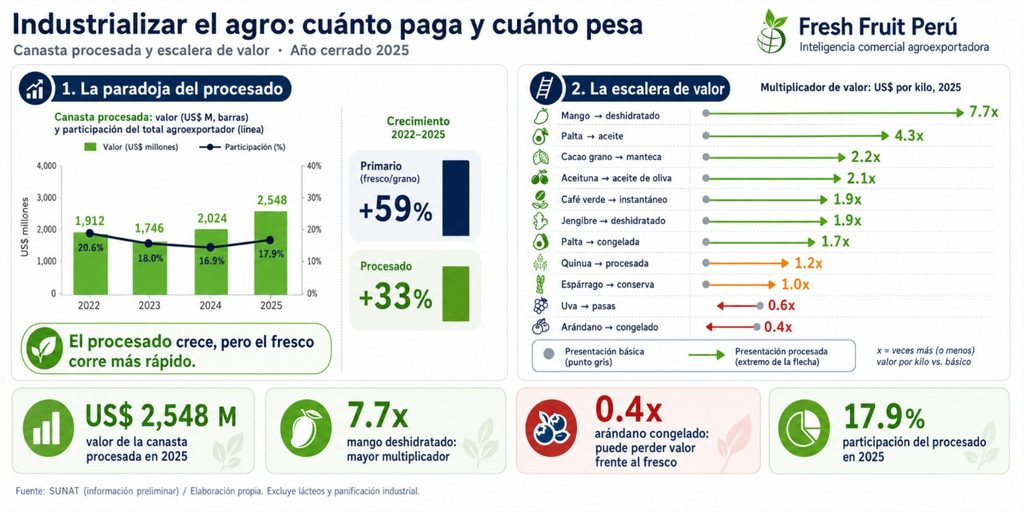
The processed product basket generated USD 2.548 billion in exports in 2025, an increase of 33% compared to 2022. Most industries would celebrate this result. The agricultural sector cannot. During the same period, the primary product basket, including fresh fruit, green coffee, and cocoa beans, grew by 59%. As a result, the share of processed products fell from 20.6% to 17.9% of total agricultural exports.
The industrialization of Peru’s agricultural sector is growing in export value, but losing ground in its overall share of exports. This is mainly due to the strong growth of fresh blueberries, grapes, and avocados, together with record prices for green coffee and cocoa beans. Peru is a leading producer of premium quality fresh food that is highly valued around the world. Buyers do not always pay a higher price, but once they experience the quality of Peruvian products, demand continues to grow. During the first half of 2026, the share of processed products increased again to 20.6%. This is expected because the first half of the year falls outside the main export season for Peru’s leading fresh fruit products, giving processed products a larger share of total exports.
The Value Ladder: Where Processing Adds Value and Where It Does Not
When each crop is analyzed separately, the results for 2025 are clear. The greatest increase in value comes from drying and oil extraction. Dehydrated mangoes are exported at 7.7 times the price of fresh mangoes, reaching USD 9.81 per kilogram compared to USD 1.28. Avocado oil reaches 4.3 times the value of fresh avocados, with an export price of USD 7.53 per kilogram compared to USD 1.77.
They are followed by cocoa butter, worth 2.2 times the value of cocoa beans, olive oil at 2.1 times the value of table olives, and both instant coffee and dehydrated ginger at 1.9 times the value of their fresh products.
Some processed products show only a small increase in value. Processed quinoa reaches only 1.2 times the price of raw quinoa, while preserved asparagus shows almost no difference at 1.0 times, as premium fresh asparagus has already matched the value of the processed product.
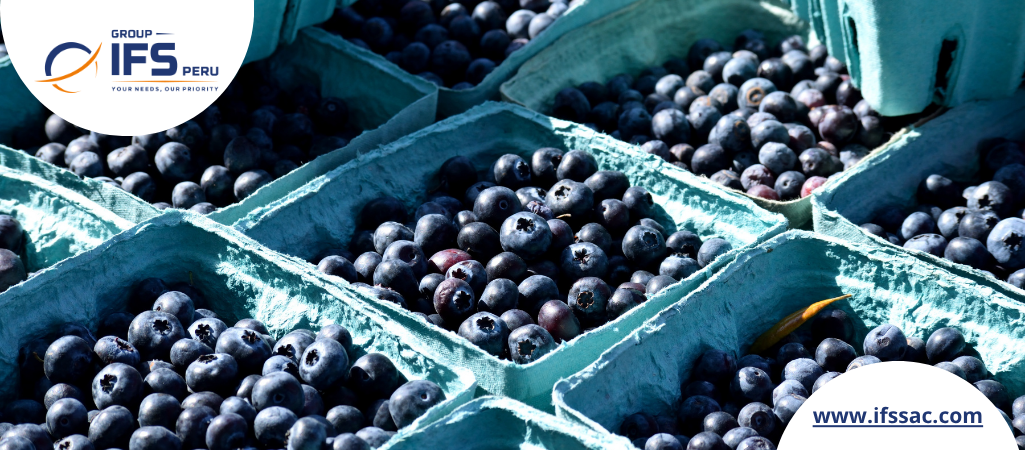
There are also cases that are often overlooked. Processing can actually reduce value. Raisins are worth 40% less per kilogram than Peruvian fresh table grapes. This is because Peru exports premium counter season grapes that are worth more as fresh fruit than as raisins. Frozen blueberries are also worth only about one third of the value of fresh blueberries, with an export price of USD 2.39 per kilogram compared to USD 6.50.
This does not mean these businesses are unprofitable. Frozen products make it possible to sell fruit that does not meet fresh export standards or cannot withstand long transportation. This explains why frozen exports continue to grow, reaching USD 61 million for frozen blueberries and USD 119 million for frozen avocados. Their purpose is not to create a premium product, but to recover value from fruit that might otherwise have no commercial value at all.
The Conversion Factor: Understanding Processing Yields
The value multiples presented above compare one kilogram of a fresh product with one kilogram of a processed product. In other words, they compare the weight of the final product. However, there is one important factor that is often overlooked: producing one kilogram of a processed product requires several kilograms of raw material.
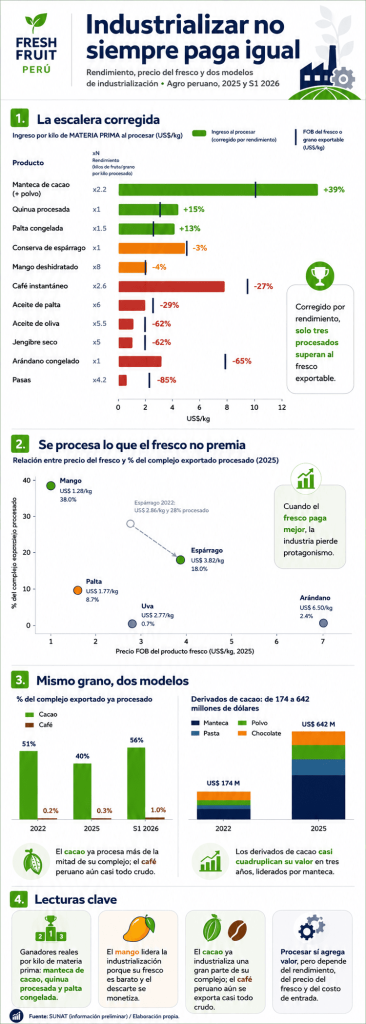
For example, producing one kilogram of dehydrated mango requires about eight kilograms of fresh mangoes. One kilogram of avocado oil requires between five and eight kilograms of fresh avocados. One kilogram of cocoa butter requires 2.2 kilograms of cocoa beans, while one kilogram of instant coffee requires 2.6 kilograms of green coffee.
When the export value of the processed product is divided by the amount of raw material required, the value difference becomes much smaller. Dehydrated mango generates USD 1.23 per kilogram of fresh fruit used, almost the same as exporting fresh mangoes at USD 1.28 per kilogram. Avocado oil generates USD 1.26 per kilogram of fresh avocados, compared to USD 1.77 for fresh exports.
In other words, in these cases, processing allows producers to obtain a value that is very close to the export price of premium fresh fruit. This becomes a useful strategy when conditions make it difficult to sell fresh produce. For example, during an El Niño event, fruit may lose its visual quality for the final consumer. Processing can also increase the value of fruit that would otherwise become waste in the field.
When the value is analyzed on the basis of each kilogram of fresh fruit used, very few processed products generate more value than exporting premium quality fresh produce. There are only three clear exceptions. Cocoa butter generates 39% more value than exporting cocoa beans, especially because its byproduct, cocoa cake, is later processed into cocoa powder. Processed quinoa generates 15% more value, while frozen avocados generate 13% more.
Does this mean that the other processed products are not profitable? Not at all. It simply means that their raw material is not, and should not be, premium quality export fruit.
Drying facilities and oil extraction plants are designed to process fruit that does not meet premium export standards, such as smaller sizes, fruit harvested outside the main export season, or fruit with skin defects. The objective is to increase the value of fruit that cannot be sold at the regular export price. Instead of losing value in the fresh market, that fruit can be processed and sold as part of a product such as dehydrated mango. Premium export quality fruit, however, should continue to be sold as fresh produce and should not be diverted to processing facilities.
Processing What the Fresh Market Does Not Reward
The processing industry depends on the volume generated by the fresh market. Every crop should have a clear objective: to sell as much premium quality fresh produce as possible, since it usually offers the highest returns and only a small portion needs to be processed. However, there will always be products that require new processed markets. The main objective should be to maintain or improve the profit generated per kilogram.
The 2025 data clearly illustrates this point. Mangoes, the lowest priced fresh product among Peru’s leading agricultural exports at USD 1.28 per kilogram, are also the country’s most processed crop, with 38% of their export value coming from processed products. Blueberries, the highest priced fresh product at USD 6.50 per kilogram, have only 2.4% of their exports processed, while premium grapes reach just 0.7%.
Asparagus provides another clear example. In 2022, 28% of its exports were processed. As the export price of fresh asparagus increased from USD 2.86 to USD 3.82 per kilogram, the share of preserved asparagus fell to 18%. These figures show that the processing industry works as a safety net, becoming more important when the fresh market no longer offers premium prices.
Two Different Models: Cocoa and Coffee
The current stage of Peru’s agricultural processing industry can be clearly seen by comparing its two flagship crops: cocoa and coffee.
In 2025, 40% of the export value of the cocoa sector came from processed products. Exports of cocoa butter, cocoa paste, cocoa powder, and chocolate reached USD 642 million, almost four times the USD 174 million exported in 2022. In addition, 219 companies exported processed cocoa products, compared to 158 companies exporting cocoa beans. During the first half of 2026, as cocoa bean prices returned to more normal levels, the share of processed cocoa products increased to 56%.
Coffee presents the opposite situation. Of the USD 1.905 billion exported in 2025, roasted and instant coffee represented only USD 5.2 million, or 0.3% of the total. This means that 99.7% of Peru’s coffee is still exported as green coffee. Meanwhile, Colombia operates Buencafé, a freeze-dried coffee plant in Chinchiná that exports instant coffee to 60 countries and provides 1,100 direct jobs.
Why has cocoa succeeded while coffee has not?
The answer has less to do with farming and more with investment. Cocoa processing is profitable at production volumes that Peru has already achieved. For example, Machu Picchu Foods accounts for 73% of Peru’s cocoa powder exports. In contrast, producing competitive instant coffee requires processing plants capable of handling thousands of tons per year, investments of tens of millions of dollars, and access to global buyers who already have established suppliers in Colombia, Brazil, and Vietnam.
This leads to an important question that is rarely asked before calling for greater added value: How much does it actually cost to enter these industries?
The Cost of Entry: A Decision Map
A processed product may generate a higher export price per kilogram, but that does not automatically make it a good business. Investment costs, processing losses, energy costs, and the minimum production scale required to compete must also be considered. Based on international feasibility studies, the different processing technologies can be compared from this perspective.
The results clearly identify one outstanding opportunity. Dehydrated fruit offers the best combination of high value and relatively low investment. It increases export value by 7.7 times per kilogram of finished product, while requiring an investment that is within the reach of a small or medium sized company. Even so, dehydrated mango exports total only USD 20 million. As explained earlier, its profitability does not come from competing with premium fresh fruit, but from creating value from fruit that cannot be exported fresh. This is precisely why a relatively low investment requirement is essential to the business model.
Avocado oil is another excellent opportunity, and the market is already responding. Exports increased from USD 8 million during the first half of 2025 to USD 22 million during the same period of 2026, representing 175% growth and exceeding the total exported during all of 2025 in only six months.
At the other end of the scale, producing competitive instant coffee requires investments of tens of millions of dollars and a long-term commitment. It is the type of project that requires a national strategy rather than the investment capacity of a medium sized company.
Finally, products such as raisins and generic fruit juices remind us of one important rule. When the fresh product already commands a premium price, the processing industry must either use a different type of raw material or develop a different product format.
What Other Countries Are Doing That Peru Still Is Not
A comparison with other countries in the region provides three useful examples.
Colombia developed its coffee processing industry through a collective decision. The Buencafé plant is owned by the National Federation of Coffee Growers because no single company could justify the capital investment on its own. If Peru wants to stop exporting 99.7% of its coffee as green coffee, it will likely require a similar collective approach.
Mexico has built an entire value-added industry around avocados, including frozen guacamole and avocado oil. Peru, despite being the world’s second largest exporter of avocados, exports only USD 2 million in guacamole.
The Philippines and Thailand have turned dehydrated mango into a global snack category. Peru produces mangoes with an excellent flavor profile and has its own export season, yet dehydrated mango exports total only USD 20 million. However, the sector continues to grow, increasing from USD 8 million in 2022 to USD 14 million during the first half of 2026 alone.
The good news is that Peru is already making progress. Avocado oil, dehydrated mango produced by companies such as Agrofino and Sunshine, cocoa processing, which already represents more than half of the cocoa sector during the first half of 2026, and frozen products that create value from fruit that cannot be exported fresh are all examples of this transition. Peru’s processing industry is not standing still. It is moving forward by choosing opportunities that make financial sense and require more manageable investments.
Key Findings
- Processed products continue to grow, but fresh exports are growing faster. The processed product basket increased by 33% since 2022, reaching USD 2.548 billion in 2025. However, its share of total agricultural exports fell from 20.6% to 17.9%, as fresh blueberries, grapes, and avocados expanded even faster.
- The value per kilogram can be misleading if the conversion rate is ignored. Dehydrated mangoes are worth 7.7 times more per kilogram of finished product, but each kilogram requires eight kilograms of fresh fruit. This results in a return of USD 1.23 per kilogram of fresh fruit, almost the same as exporting fresh mangoes. After adjusting for conversion rates, only cocoa butter with 39%, processed quinoa with 15%, and frozen avocados with 13% generate higher value than exporting the fresh product.
- The real business of processing is making use of fruit that cannot be exported fresh. Since very few processed products generate more value than premium fresh produce, processing plants rely on fruit that cannot be sold in the fresh market because of size, harvest timing, or cosmetic defects. Processing does not compete with fresh exports. It complements them by creating value from fruit that would otherwise have very little commercial value.
- Products are processed when the fresh market no longer offers premium prices. Mangoes, the lowest priced fresh product at USD 1.28 per kilogram, are also the most processed crop, with 38% of exports coming from processed products. Blueberries, the highest priced fresh product at USD 6.50 per kilogram, process only 2.4% of their exports. As the price of fresh asparagus increased from USD 2.86 to USD 3.82 per kilogram, the share of preserved asparagus fell from 28% to 18%.
- Frozen products create value from fruit that cannot be sold fresh, not from premium fruit. Although frozen products have a lower export value per kilogram than fresh produce, they transformed fruit that could not be exported into USD 367 million in exports. Their success should be measured by the value they recover rather than by the price per kilogram.
- Cocoa reached 40% processing, while coffee reached only 0.3%. Processed cocoa products represented 40% of the sector’s export value in 2025 and 56% during the first half of 2026. Coffee reached only 0.3%. The difference is not related to agriculture, but to investment. Cocoa processing requires millions of dollars, while competitive instant coffee production requires investments of tens of millions of dollars.
- The biggest opportunity is dehydrated fruit, while avocado oil is growing the fastest. Dehydrated fruit combines the highest value increase, 7.7 times, with one of the lowest investment requirements, starting at approximately USD 100,000, yet it remains underdeveloped. Avocado oil has already taken off, growing 175% year over year and reaching USD 22 million during a single semester.
- Instant coffee is a national scale project. With a minimum production capacity of approximately 1,000 tons per year and investments ranging from USD 20 million to more than USD 100 million, it is beyond the reach of a medium sized company. The Buencafé model, based on collective investment by the coffee sector, remains the best example.
The conclusion is clear. Processing does create value, but each type of processing offers a different opportunity. Peru has already taken advantage of the processing technologies that require lower investment and work well with products that do not receive premium prices in the fresh market, such as cocoa and frozen products. The next step includes oils and dehydrated products. More complex industries, such as instant coffee and large-scale freeze drying, will require patient capital and most likely collective investment rather than individual efforts. In the meantime, every container of dehydrated mango transforms fruit that could not have been exported fresh into a product worth USD 9.81 per kilogram, proving that the opportunity already exists and that the first step is well within the reach of a small or medium sized company.
Source: Fresh Fruit Portal